
For years, SEOs have used pogo-sticking to describe a familiar pattern: someone clicks a Google result, quickly comes back, and tries another result.
The usual theory is equally simple. The first page failed, the second page succeeded, and Google uses that sequence to move one result down and the other up.
Google told site owners not to think about it that way. Then internal API documentation leaked,
showing fields with names such as goodClicks, badClicks, and lastLongestClicks. Evidence made
public in the US antitrust case also described Navboost, a Google ranking system built around
clicks.
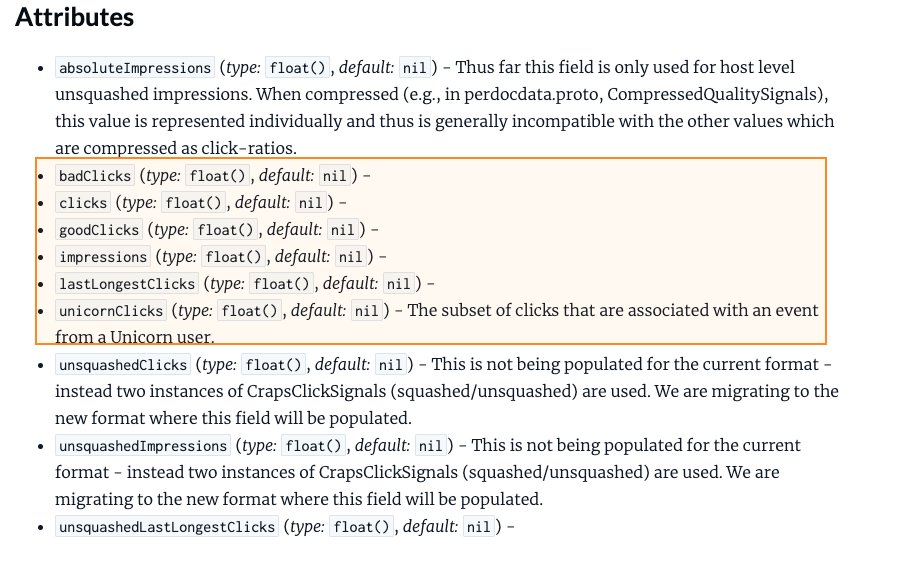 Screenshot from the leaked documents, revealing different "click"-related fields.
So was Google lying? The honest answer is more useful than a dramatic one: Google uses aggregated click behavior in ranking, but the leak does not prove that every quick return is a direct penalty against an individual page.
This is the first article in our Google leak series. In each part, we will separate what the documents show, what other evidence confirms, and what remains speculation.
First, what is pogo-sticking?
Imagine searching for "how to clean a coffee grinder."
- You click the first result.
- The page opens with a long personal story, several ads, and no visible instructions.
- You return to the search results.
- You click another result and find the answer.
That movement from the results to a page, back to the results, and into another page is pogo-sticking. It can look like dissatisfaction, but context matters.
A quick return is not always a failure. A searcher may be comparing products, checking several sources, opening tabs, or looking for a fact that takes five seconds to confirm. That ambiguity is why reducing the idea to "short visit bad, long visit good" has always been unreliable.
Pogo-sticking is also not the same as bounce rate. Bounce rate is an analytics measurement on your site. Google can observe clicks on its own search results without reading your Google Analytics account, and someone can bounce from your site without returning to Google at all.
What Google denied
In a 2018 Webmaster Central hangout, Google's John Mueller was asked whether a poor experience followed by a return to the results would affect a page or its wider site. He said Google tried not to use signals like that for search and advised site owners not to focus on them at an individual page level. Search Engine Journal preserved the question and answer.
There was nuance even in that denial. Mueller also said Google examines how users react when evaluating algorithm changes across millions of queries and pages. His distinction was between using behavior at scale to judge search quality and treating one page's back-clicks as a simple ranking factor.
That distinction matters because the evidence that followed supports the first use much more strongly than the second.
Then came Navboost
Before the leak became public, the 2023 US antitrust trial had already put Navboost into the record.
A US Department of Justice trial exhibit described Navboost as Google's original system for learning from clicks and presented it as a particularly powerful part of ranking. The plaintiffs' proposed findings of fact cite Google testimony that Navboost records clicks for queries, is used in ranking, and learns from 13 months of click data.
This is stronger evidence than an SEO correlation study. It comes from Google's own documents and testimony produced in court.
It also changes the question. We no longer need to ask whether Google uses clicks at all. The useful questions are which clicks it uses, how it interprets them, and at what level they affect results.
What the 2024 Google leak added
In March 2024, internal API documentation from Google's Content Warehouse was accidentally published to a public repository. The material ran to more than 2,500 pages and described over 14,000 attributes. It was discovered and shared with Rand Fishkin, who published an initial analysis in May.
Google subsequently confirmed that the documents were authentic, but warned against drawing conclusions from information that could be incomplete, outdated, or missing context. That warning is fair. An API schema tells us that a field exists; it does not tell us its weight, whether it is active in every search system, or exactly how engineers define it.
Still, the field names are revealing. Fishkin's review of the leaked documentation identified click-related attributes tied to Navboost and related systems:
| Field | What the name suggests | What we can safely say |
|---|---|---|
goodClicks | Clicks associated with satisfaction | Google stores or processes a category with this name; the leak does not give us its exact rules. |
badClicks | Clicks associated with dissatisfaction | The category exists in the documentation; a quick return is a plausible example, not a published definition. |
lastLongestClicks | The final or longest click in a search journey | Google distinguishes more than raw click-through rate and appears to consider a click's place in a search session. |
unsquashedClicks and squashedClicks | Raw and processed click counts | Clicks are filtered or normalized rather than counted as equal votes. |
This is the part of the leak most closely related to pogo-sticking. Google does not appear to ask only, "Did this result get clicked?" It has systems capable of separating kinds of clicks and looking at what happened across a search journey.
The evidence, without the hype
It helps to separate four claims that are often bundled together:
| Claim | Strength of evidence |
|---|---|
| Google records clicks on search results. | Confirmed. Search Console reports clicks, and court testimony describes Navboost recording them. |
| Google uses aggregated click data in ranking. | Strongly confirmed. Google's court evidence describes Navboost as a ranking system trained on user clicks. |
| Google distinguishes among click types or qualities. | Strongly supported. The leak documents goodClicks, badClicks, lastLongestClicks, and click processing. |
| One person returning quickly causes that page to lose rankings. | Not established. No public evidence gives us a per-click rule, threshold, or weight. |
There is supporting history, too. A Google patent for scoring site quality describes measuring the time between a click on a search result and a return to the results, then using aggregated visit durations in a quality score. A patent proves that Google developed and protected an approach, not that the exact method is running today. It is corroboration, not confirmation.
The combined picture is nevertheless hard to dismiss: public denials made click behavior sound largely irrelevant to individual site owners, while internal documentation and sworn testimony show that clicks are an important input to Google's ranking systems.
What a good click and a bad click probably mean
The leaked documentation names the categories but does not define them for us. Anyone claiming that a good click starts at exactly 30 seconds, or that a bad click automatically causes a demotion, is adding certainty that the evidence does not contain.
A safer interpretation is:
- A good click contributes to a pattern suggesting that a result satisfied a query.
- A bad click contributes to a pattern suggesting that it did not.
- A last longest click may help identify the result that finally ended or best satisfied a search journey.
The word pattern is doing important work. Google has to correct for position bias — the first result naturally receives more clicks — as well as query type, device, location, spam, and the many legitimate reasons someone might return. The processed click fields suggest that raw clicks are filtered rather than treated as a public voting button.
This also explains why buying clicks or asking a crowd to search for your brand is a poor strategy. The system described in the evidence is designed to learn from large, normalized patterns, not be fooled by a burst of identical behavior.
What site owners should do differently
There is no "pogo-sticking score" in Search Console. What we can do is build an honest proxy for one: we will never see the click back to the results page, but we can measure what the visitors you earn from search do once they arrive — per page, whether they stay and engage or leave within seconds.
That is the proxy Search Analytics in Unhidden is built on. One script tag on your site counts only the visitors arriving from search engines and AI assistants, then reports bounce rate and active time per page for that audience alone — not diluted by direct visits, social traffic, and bots. The pages where search visitors consistently land and leave almost immediately are, in practice, your pogo-sticking shortlist.
A proxy should be read as evidence, not as a Google score: a fast exit can also be a question answered in five seconds. Either way, the useful response is to reduce the reasons a qualified searcher would feel misled or blocked.
Match the query, not just the keyword
A page can be excellent and still be wrong for a particular query. Check the dominant search intent: does the searcher want a definition, instructions, a comparison, a tool, or a product page?
Keep the promise made in the result
The title and description earn the click. The page must immediately deliver what they promised. Clickbait can improve raw click-through rate while producing the kind of dissatisfied journey that click-quality systems are built to detect.
Put the answer before the obstacle
Make the main answer visible early. Slow loading, intrusive overlays, vague introductions, and burying the useful section beneath filler all give searchers a reason to go back.
Use your own evidence
Search Console can show which query-page pairs receive impressions and clicks. Your analytics can show whether those visitors continue, convert, or immediately leave. Neither tool exposes Navboost's internal click labels, but together they can reveal a mismatch between the search promise and the landing page.
The practical conclusion
Pogo-sticking is real as a user behavior, and the evidence shows that Google uses sophisticated click data in ranking. The simplistic SEO story — one fast return equals one negative vote — is not supported.
That should be reassuring. You do not need to trap people on a page, stretch an answer to increase time on site, or chase an imaginary number of seconds. You need to make the right searcher glad they clicked.
That is a harder goal to fake and a much better one to optimize for.